How to Handle Choking in Babies and Young Children: A Parent’s Guide
March 13, 2026
Few situations are more frightening for a parent than seeing their baby or young child struggle to breathe. Choking can happen suddenly and often when you least expect it, during a meal, while playing with a toy, or when a curious toddler picks up something small from the floor.
The good news is that while choking emergencies are serious, they are also one of the most preventable and manageable childhood emergencies when parents know what to do. Understanding the signs of choking and learning the correct first aid techniques can help you respond quickly and confidently if it ever happens.
In this guide, we will look at why choking happens, what the warning signs are, and how parents and caregivers can respond safely if a baby or child begins to choke.
Why Babies and Young Children Are at Higher Risk of Choking
Babies and young children are naturally curious. They explore the world through touch, taste, and movement. Unfortunately, this also means that they often place objects into their mouths as part of normal development.
Several factors make infants and young children particularly vulnerable to choking:
Small airways
A child’s airway is much smaller than an adult’s, which means even small objects can easily block breathing.
Developing chewing skills
Young children are still learning how to chew food properly and may swallow pieces that are too large.
Limited awareness of danger
Toddlers may run, laugh, or talk while eating, which increases the risk of food entering the airway.
Because of these factors, choking incidents are most common in children under five years old.
Common Choking Hazards for Children
Many choking emergencies involve everyday objects that parents may not immediately recognise as risks.
Common food choking hazards
Certain foods are more likely to block a child’s airway, especially if they are round, firm, or sticky. These include:
- Whole grapes
- Cherry tomatoes
- Nuts
- Popcorn
- Hard sweets
- Hot dogs or sausages
- Large chunks of apple or carrot
- Peanut butter on a spoon
Foods that are round or cylindrical can completely block the airway if swallowed without being chewed properly.
Small household objects
Children also frequently choke on non-food items such as:
- Coins
- Buttons
- Marbles
- Small toy parts
- Batteries
- Beads
For babies who are crawling or exploring the floor, even tiny objects can become choking hazards.
Recognising the Signs of Choking
One of the most important skills parents can learn is how to recognise when a child is truly choking.
A child who is choking may show some of the following signs:
- Difficulty breathing
- Silent or ineffective coughing
- High-pitched or wheezing sounds
- Clutching their throat
- Panic or distress
- Blue or pale lips
- Inability to cry or speak
One key point to remember is that a child who can cough or cry is still moving air. In these cases, coughing may help clear the airway naturally.
However, if the child cannot breathe, cry, or cough, immediate action is required.
What To Do If a Baby Is Choking (Under 1 Year)
First aid techniques for choking are different for babies and older children. Because infants are fragile, abdominal thrusts should not be used.
Instead, the recommended technique involves back blows and chest thrusts.
Step 1: Call for help
If possible, ask someone nearby to call emergency services while you begin first aid.
Step 2: Position the baby
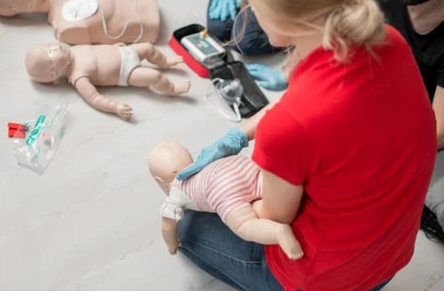
Hold the baby face-down along your forearm, supporting their head and neck. The baby’s head should be slightly lower than their body.
Step 3: Deliver back blows
Using the heel of your hand, give five firm back blows between the baby’s shoulder blades.
These blows help create pressure in the airway that may dislodge the object.
Step 4: Turn the baby over
If the object does not come out, turn the baby onto their back while still supporting their head.
Step 5: Give chest thrusts
Place two fingers in the centre of the baby’s chest and give five quick chest thrusts.
Continue alternating five back blows and five chest thrusts until the object is expelled or the baby becomes unresponsive.
If the baby becomes unconscious, CPR should be started immediately while emergency services are contacted.
What To Do If a Child Is Choking (Over 1 Year)
For older babies and young children, abdominal thrusts, commonly known as the Heimlich manoeuvre, may be used.
Step 1: Encourage coughing
If the child is coughing strongly, encourage them to keep coughing. This may clear the airway without further intervention.
Step 2: Deliver back blows
If coughing is ineffective, stand behind the child and lean them slightly forward.
Give five firm back blows between the shoulder blades using the heel of your hand.
Step 3: Perform abdominal thrusts
If the object remains stuck:
- Stand behind the child
- Place your arms around their waist
- Make a fist just above the navel
- Grasp your fist with the other hand
- Deliver quick inward and upward thrusts
Repeat cycles of five back blows and five abdominal thrusts until the object comes out or the child becomes unresponsive.
If the child loses consciousness, begin CPR and call emergency services immediately.
Preventing Choking in Babies and Young Children
While knowing how to respond is important, prevention is always the first line of defence.
Parents can significantly reduce choking risks by making a few simple adjustments.
Food safety tips
- Cut grapes and cherry tomatoes into quarters
- Slice hot dogs lengthwise
- Avoid giving nuts to young children
- Cook hard vegetables until soft
- Encourage children to sit while eating
Children should never run, play, or lie down while eating.
Toy safety
Always choose toys appropriate for your child’s age group. Toys designed for older children may contain small parts that pose choking hazards.
A simple rule many parents use is the toilet paper roll test: if an object can fit through a toilet paper roll, it is small enough to block a young child’s airway.
Supervision matters
Close supervision during meals and playtime can help prevent many choking incidents before they occur.
Why First Aid Training Makes a Difference
Reading about choking first aid is helpful, but practical hands-on training builds real confidence.
In a structured first aid course, parents can:
- Practise choking rescue techniques on training mannequins
- Learn infant and child CPR
- Understand how to recognise serious emergencies
- Gain confidence in responding quickly and safely
Many parents say that after completing a course, they feel far more prepared to handle emergencies involving their children.
Confidence Comes From Preparation
Choking emergencies are every parent’s nightmare, but they are also situations where knowledge and preparation can make an enormous difference.
Understanding the risks, recognising the signs of choking, and knowing the correct first aid techniques can help parents act calmly and effectively when seconds matter.
While we hope these skills are never needed, being prepared can provide peace of mind and may one day help save a life.
Every parent wants to protect their child. Learning first aid and CPR is one of the most powerful ways to do exactly that.