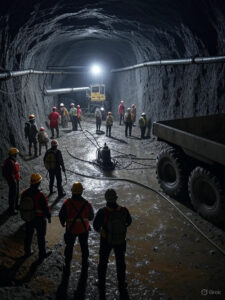
The overarching objective is to ensure that the mining fleet is optimally deployed, maintained, and expanded to meet production targets and sustain operational efficiency throughout the mine’s lifecycle.
Phase 1: Planning and Assessment
- Current Fleet Assessment & Gap Analysis:
- Future Requirements Definition:
- Strategy Formulation (Refurbish vs. Procure vs. Rent):
Phase 2: Execution and Implementation
- Detailed Design & Specification:
- Procurement & Contract Management:
- Refurbishment & Conversion Execution:
- Delivery & Commissioning:
- Rental Fleet Integration:
Phase 3: Monitoring, Control, and Optimization
- Performance Monitoring & Tracking:
- Maintenance & Support:
- Risk Management & Mitigation (Continuous):
- Continuous Improvement:
Potential Risks and Delays
Mine development, especially with a strong emphasis on fleet management, is susceptible to various risks and delays that can impact project timelines, costs, and overall success.
Procurement and Supply Chain Risks:
- Vendor Delays: Risk: Manufacturers failing to meet agreed-upon delivery schedules for new equipment (primary, secondary, HPE rigs, power packs). Delay Impact: Production shortfalls, idle workforce, increased operating costs due to reliance on older, less efficient equipment or costly short-term rentals. Mitigation: Diversify suppliers, include penalty clauses in contracts, conduct rigorous vendor performance monitoring, maintain open communication with suppliers.
- Component Shortages: Risk: Unavailability of critical components for new builds or refurbishment (e.g., specific engines, hydraulic parts, electronic systems). Delay Impact: Extended refurbishment times, delayed commissioning of new equipment. Mitigation: Early procurement of long-lead items, maintain strategic spares inventory, explore alternative compatible components.
- Logistical Challenges: Risk: Delays in shipping, customs clearance, or transportation of heavy equipment to the mine site, especially for international procurements. Delay Impact: Significant project schedule slippage, increased freight costs. Mitigation: Engage experienced logistics providers, conduct thorough route planning, anticipate customs requirements, and factor in contingency time.
- Price Volatility: Risk: Unforeseen increases in equipment prices, spare parts, or raw materials (e.g., steel for fabrication). Delay Impact: Budget overruns, potential delays if re-approval for increased funds is required. Mitigation: Fixed-price contracts where possible, early budget allocation with contingencies, hedging strategies.
Refurbishment and Conversion Risks:
- Undiscovered Defects: Risk: Additional hidden defects or wear found during refurbishment that were not apparent during initial assessment. Delay Impact: Increased refurbishment time, higher costs, potential need for additional specialized parts. Mitigation: Thorough pre-refurbishment inspections (e.g., non-destructive testing), clear scope of work with contingency for unknowns, experienced refurbishment contractors.
- Skilled Labor Shortages: Risk: Lack of qualified technicians or engineers for complex refurbishment tasks or specialized conversions (e.g., Low Profile Manitous). Delay Impact: Reduced quality of work, extended downtime for equipment. Mitigation: Partner with reputable service providers, invest in internal training, cross-train personnel.
- Quality Control Issues: Risk: Substandard refurbishment work leading to premature failures or reduced equipment lifespan. Delay Impact: Frequent breakdowns, increased maintenance costs, safety hazards. Mitigation: Implement rigorous quality assurance processes, conduct regular inspections during refurbishment, robust post-refurbishment testing.
Operational and Integration Risks:
- Inadequate Training: Risk: Operators not adequately trained on new or refurbished equipment, leading to inefficient operation, higher wear and tear, or safety incidents. Delay Impact: Reduced productivity, increased maintenance burden, potential for accidents. Mitigation: Comprehensive operator training programs, simulation training, gradual integration of new equipment.
- Integration Challenges: Risk: New or refurbished equipment not seamlessly integrating with existing mine systems, infrastructure, or operational procedures. Delay Impact: Downtime for troubleshooting, loss of productivity. Mitigation: Thorough compatibility assessments, phased integration, robust testing prior to full deployment.
- Unforeseen Ground Conditions/Operational Changes: Risk: Encountering unexpected geological conditions, changes in orebody characteristics, or shifts in mining plan that impact fleet requirements. Delay Impact: Need for different equipment, operational adjustments, potential delays in development progress. Mitigation: Comprehensive geological modeling, flexible fleet deployment strategies, strong communication between planning and operations.
Rental Specific Risks:
- Availability of Rental Fleet: Risk: Inability to secure the required specialized rental equipment (Bolters & Drill Rigs) at the desired time or for the necessary duration. Delay Impact: Delays in critical development activities like ground support or drilling. Mitigation: Establish long-term relationships with reputable rental companies, pre-book equipment, explore multiple rental options.
- Rental Equipment Condition/Reliability: Risk: Receiving poorly maintained or unreliable rental equipment. Delay Impact: Increased downtime, additional maintenance costs, impact on productivity. Mitigation: Thorough inspection of rental equipment before acceptance, clear service level agreements with rental providers, contingency plans for breakdowns.
By systematically addressing these risks within the proposed methodology, a mine can significantly enhance its chances of successful development, ensuring the fleet remains a strategic asset rather than a source of delays and cost overruns.